

Go Back
News
School News
When Literature Meets AI | A Documentary of Yew Wah Beijing Grade 8 Interdisciplinary Exploration
School News
28 Apr, 2026
15 : 46
Project Origin
From Words on the Page
to Genuine Inquiry
A book titled Klara and the Sun opened the door of intertwined reflections on artificial intelligence and humanity for the Grade 8 students at Yew Wah Beijing Campus.
The story of the AI robot Klara, who persistently seeks to understand human emotions and offers protective companionship, transformed abstract discussions about emotions, machines, and the boundaries of human nature into sincere questions and a desire for exploration within the students’ hearts.
The story of the AI robot Klara, who persistently seeks to understand human emotions and offers protective companionship, transformed abstract discussions about emotions, machines, and the boundaries of human nature into sincere questions and a desire for exploration within the students’ hearts.
Students candidly shared that when they first read the work, they couldn’t clearly distinguish whether Klara’s warm companionship was simply programmed or genuinely human-like in feeling. This curiosity about real-world AI became the most authentic starting point of their study tour.
Core Focus of the Study Tour
A Single Question Throughout
Rejecting Superficial Observation
The entire study tour revolves closely around the central question: “Can Klara possess a human heart?” This drives a deep integration of literary reflection and AI practice, establishing a learning system of “experiential perception — critical thinking — reflective creation.” Each student carries a personalized inquiry task sheet, actively observing, hands-on practicing, and probing deeply with questions. Every experience is tightly connected to the core theme, accumulating valuable material for subsequent project exploration.
Students expressed that previously they were amazed only by the powerful capabilities of robots, but this time, guided by reflections on Klara, they truly began to discern the fundamental difference between technology and the human heart.
Immersive Practice
Hands-On Interaction with Technology Thoughtful Reflection on Boundaries
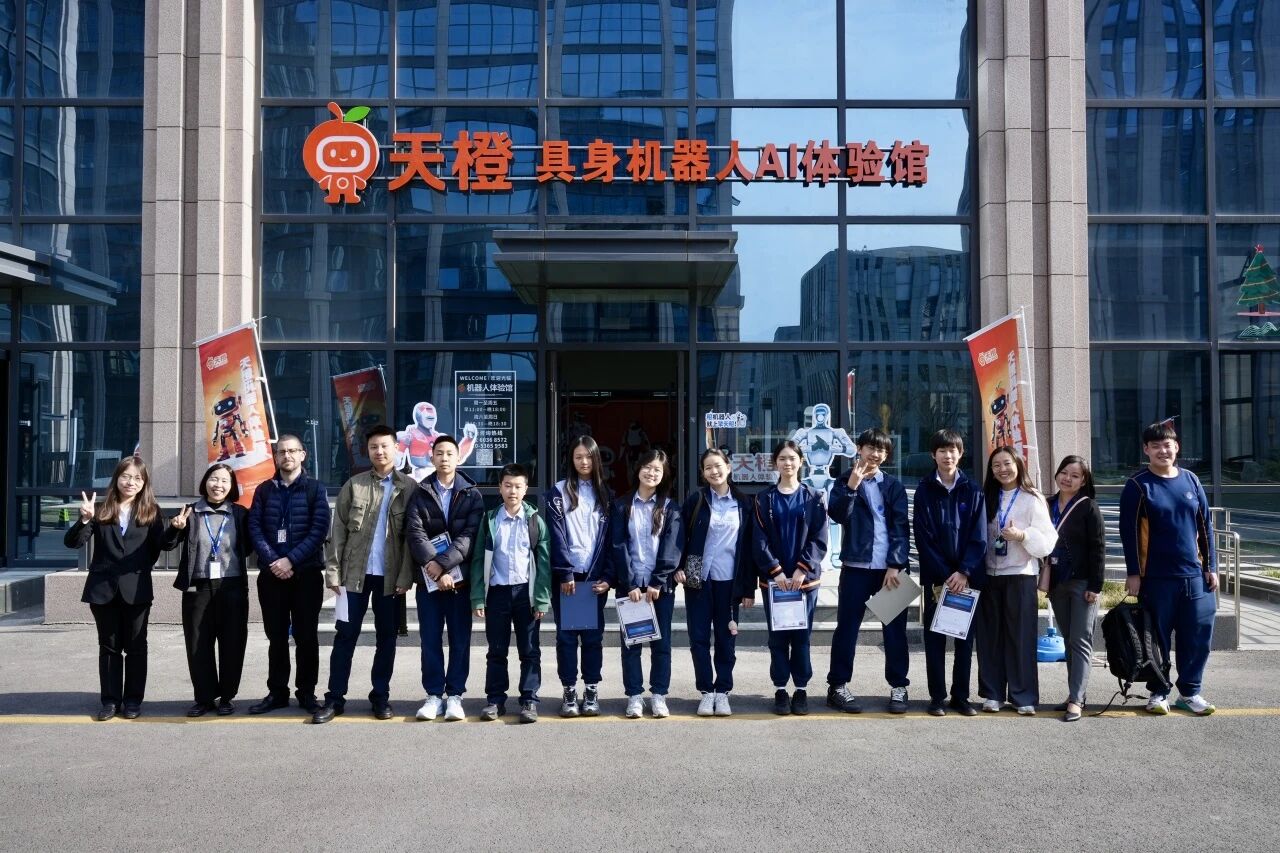
The wheel-legged robot operation experience serves as the core practical activity of the study. Students set the robotic ’s movement path through basic programming, clarifying the connection between commands and machine behaviour, and understanding that AI actions are entirely driven by programming rather than autonomous consciousness. They ultimately control the robotic arm to complete the ball-pushing challenge while simultaneously observing and recording whether the machine possesses human-like emotions and autonomous judgment.
After the hands-on session, students reflected that the robotic strictly follows programmed instructions without independent thoughts and does not proactively offer care like Klara does. Klara’s warmth is a humanistic brilliance bestowed by the author, not an emotion inherent to the machine itself. This insight became the core basis for exploring the central question.
Humanoid Robot Interaction
Distinguishing Between Programming and Emotion
At the humanoid robot interaction station, students engaged with cutting-edge robots through fun puzzles and idiom word games, experiencing their language interaction capabilities. Meanwhile, they recorded the robots’ response patterns according to their task sheets and critically reflected on whether the smooth interactions represented genuine emotional expression or merely programmed mechanical feedback.
During discussions, everyone noted that while robots can provide logically coherent answers, these are simply matches from a database without real emotions. In contrast, Klara in the book exhibits empathy in response to her owner’s emotional fluctuations—this heartfelt care is something current AI technology cannot replicate. Thus, the abstract literary theme becomes tangible and perceptible.
Value of the Study Tour
Learning Through Practice
Building Momentum for Results
This study tour represents a deeply integrated interdisciplinary learning experience aligned with curriculum goals. Students had close-up encounters with AI technology, gaining a clear understanding of the application boundaries of artificial intelligence, thereby laying a solid cognitive foundation for exploring the core question. Throughout the process, they collected practical materials with critical thinking, distilled personal insights, and accumulated vivid creative inspiration. The group collaboration further cultivated teamwork and inquiry skills, achieving a dual enhancement of humanistic literacy and scientific thinking.
In their reflections, students realized that while technology can advance infinitely, it can never truly encode human emotions, warmth, and sincerity. What makes Klara touching lies in the humanistic brilliance she embodies, not her AI attributes. This is the core insight the project aims to convey.
Klara in the pages of the book embodies a longing for companionship and the human heart, while AI demonstrates the power and limits of technology. This interdisciplinary study tour is a profound inquiry into “intelligence and humanity,” and a vivid practice of Yew Wah’s philosophy of “bringing learning beyond the classroom and grounding thinking in practice.” The school consistently nurtures the soul through literature and broadens horizons through technology, guiding students to think critically through practice and grow through collaboration.
On April 3rd, at the Bilingual Learning Community Showcase Day, eighth-grade students will present their unique inquiry outcomes from this study tour, sharing their distinctive insights on AI and humanity, and demonstrating authentic growth through interdisciplinary learning.


YWIES Beijing Yizhuang is a Child-Safe School
Click HERE for our Child Protection Policies and Procedures
© Yew Wah International Education School of Beijing Yizhuang 2022. All rights reserved